Preview Part II Ideological Subversion: GE Capital Cuts Financing to U.S. Gun Retailers, Financed Hitler

It was reported yesterday that GE Capital, the financing arm of General Electric Company, has made “the difficult decision” to cut off loans to existing gun retailers (Wall Street Journal Apr 24, 2013) as GE Capital spokesman said in an e-mail, “in light of industry changes, new legislation and tragic events that have caused widespread reexamination of policies on firearms” (USA Today Apr 24, 2013); GE Capital had already severed loans to new gun retailers in 2008. Earlier this week, the Senate voted down the expansion of gun control legislation. Gun shootings have appeared to come randomly out of nowhere as children, families and communities come under attack, their horror cover the media as the Administration mounts pressures for gun control.

GE Capital’s concerns over tragic events relate to the upcoming Part II of Ideological Subversion of the United States that it seems timely to preview a bit of history.

In the 1930s, General Electric vice president (Swope) was financier and architect of President Roosevelt’s New Deal praised by Fascist Premier Mussolini as “President Roosevelt’s new plan for coordination of industry follows precisely the lines of Fascist cooperation”(“Mussolini Sees World Driven Toward Fascism.” New York Times June 4, 1933). The Roosevelt family was one of the largest stockholders in General Electric Co. (Sutton, Antony. (1976). Wall Street and the Rise of Hitler p. 49).

Decades later out of the collapse of the banking and financial system in 2008, the Washington Post reported General Electric quietly became the largest beneficiary of one of the government’s key rescue programs, the Temporary Liquidity Guarantee Program, for which GE did not qualify until some back-room discussions. (“How a Loophole Benefits GE in Bank Rescue.” June 29, 2009 link). General Electric’s CEO Jeffery Immelt then joined the current Administration.

General Electric, the international industrial and financier, was a key backer of the communist Bolsheviks, the Soviet Union to the rise of Hitler. The first document on the right from the Nuremburg Tribunal is a receipt of a money transfer from the German General Electric to the election funds of Hitler dated March 2, 1933. International General Electric through its interests (OSRAM G.m.b.H, German G.E. or A.E.G., Accumulatoren Fabrik A.G., Krupp) transferred 725,000 RM in company funds to Hitler’s “Nationale Treuhand” election fund, administered by Rudolph Hess and Hjalmar Schacht (Sutton p.58). Today, that’s about Continue reading

Run, Cyprus! Leave the Euro

How does the island of Cyprus in the Mediterranean Sea get vaulted into international headlines in the past few weeks of March 2013. Moody’s downgrade was in January 2013. In November 2012, Germany intelligence warned about KGB money in Cyprus banks. June 2012? Why now? Why Cyprus?

Insolvency? Not in the same league as the largest insolvent member banks of the Federal Reserve Bank and European Central Bank. Money laundering? A United Kingdom fund manager, William Browder of Hermitage Capital warned Germany (Reuters, Mar 27, 2013) of KGB money laundering in Cyprus banks. The extent of laundering is unknown, but for reference, London’s HSBC  – Europe’s largest bank – laundered $250 billion from 2001-2007 but is “sorry” for aiding drugs lords, rogue states and terrorists. Wells Fargo-Wachovia laundered $378.4 billion for cocaine drug lords from 2004-2007. Some others.

Cyprus resembles a trial run (attempted on lot of Russian money) of the new “bail in” bank bail-out scheme outlined in a joint paper by the FDIC and Bank of England in December 2012 titled, “Resolving Globally Active, Systemically Important, Financial Institutions”. Deposit insurance is becoming a thing of the past (FDIC insurer has been in a state of insufficient funds at least since 2010 with transfusions from the Federal Reserve printer), as bank depositors-savers are now considered unsecured creditors to banks. For instance, this means in the event of a bank failure, reported as of March 30, 2013 Bank of Cyprus big depositors (over 100,000 euros or US $130,000) could lose up to 60% of their money in an EU-IMF restructuring.

Cyprus. Greece. Italy. Spain. Portugal. Ireland,… RUN. Leave the euro. It is a trap.

There is not much that is made visible, except for Cyprus’s proximity to Syria and Turkey where NATO and Russia have been stockpiling missiles. It is almost as if one were spectator to Zbigniew Brzezinski and company’s (Henry Kissinger, Rockefeller – the Chase part of JP Morgan Chase, Goldman Sachs, etc.) Grand Chessboard moves on the European continent, that incidentally, is a block of real estate adjoining Russia and China.

For a moment, let’s look at the plight of Hermitage Capital’s William Browder who warned Germany. Russia banned Browder from entering the country since 2005 (WSJ Mar 18, 2006), but he is on trial in absentia on tax evasion charges. On March 5, 2013 (Bloomberg), Russia opened a case against Hermitage Capital for illegally purchasing 131.6 million shares in Russia’s Gazprom for about 2.1 billion rubles ($70 million) at a time when foreign ownership of the world’s biggest natural-gas producer was prohibited; Browder said buying Gazprom shares through “derivative structures” was “perfectly legal”. Back in 2008, the WSJ reported Kameya, an investment vehicle on Cyprus linked to Hermitage, figured in a “gray scheme” that allowed foreign investors to get around the restrictions.

In 2009, Browder wrote a tribute “They Killed My Lawyer [Sergei Magnitsky died in a Moscow prison]” decrying Russia’s lack of rule of law, which was published in Foreign Policy (Dec. 22), whose CEO and chief editor David Rothkopf is former managing director of Kissinger Associates. In 2006, the Washington Post reported (July 13) three U.S. Senators (J.McCain, B.Frist, C.Schumer) wrote a letter to 43rd President G.W. Bush to take Browder’s – a British citizen with ties to the President and Prime Minister Tony Blair – case to Moscow as some U.S. investors had $1 billion in Hermitage, to set an example for rule of law. (Khodorkovsky’s similar plight on his purchase of Russia’s Yukos Oil and Bush (41st) is in the upcoming Part II ideological subversion of the United States.)

Browder and Edmond Safra founded Hermitage Capital Management in 1996 (WSJ Jul 13, 2006) and to 2005 was among the biggest foreign investors in Russia. Safra founded the Republic National Bank of New York (known as a gold bullion house, currency dealer) and Safra Republic Holdings of Luxembourg. Safra sold both to London’s HSBC for nearly $10 billion before his death on December 3, 1999. Safra’s murder from an arson in his Monaco house remains shrouded in mystery that extended to much of his bank dealings. Henry Kissinger’s comments upon Safra’s death (WSJ Dec. 6, 1999) are rather interesting given they were personal friends for 20 years. Denials of Safra’s Republic Bank alleged links to drug money laundering, the Iran-contra affair, CIA operations accompany suggestions Republic laundered Russian money.

On March 13, 2013, Russian journalists reported Safra was planning to give testimony to the FBI when Safra was killed. The bureau was investigating the fate of the stabilization credit that the IMF extended to Russia in 1998, which vanished from accounts at Safra’s bank at a time when Browder’s Hermitage Capital turned up significant sums of money to buy Gazprom shares. On March 26, 2013,  HSBC (Hermitage Capital’s trustee) shut down Hermitage Fund(link) as Browder is sued in London and Russian investigators threaten to seize documents from HSBC in Moscow.

[One of Republic’s largest customers was Martin Armstrong, accused of using his accounts, which represented 90% of Republic’s securities business, to defraud Japanese investors of $1 billion, described as Ponzi (USA Today Nov 21, 2001); HSBC settled. Questions remain about how much Republic knew. In a telemarketing scheme thousands of investors, many elderly, were persuaded into purchasing commodities (gold, platinum, etc.) with a 20% cash downpayment as SafraBank financed the remaining through a Texas subsidiary what came to be over 10,000 precious metals loans. Investors had no idea what they purchased in the 1980s was an OTC derivative and lost millions; in 1992, Republic settled some lawsuits.]

Leave the Euro

It is a trap. It is like telling people to go back inside a burning building. Cyprus. Greece. Spain. Italy. Portugal. Germany …and other nations in line to join the euro. Run. Walk away from it. Leave the euro with what is left of your nation’s wealth and sovereignty, if sovereignty is what you value. One can ponder the thought as a few months ago, the IMF sees the European banks face $4.5 trillion sell-off of assets (yours and the nation’s assets in exchange for printed money that was lent to you). In 2005 when the Dominican Republic suffered an economic collapse, the New York Observer (Dec 25, 2005) reported the IMF forced the country’s central bank to sell 2,000 acres of prime beachfront to a group of “20 American luminaries” – financiers, intellectuals – to “vacation, play golf and bask in the glow” of each other. The same has been done to the people in the United States. But consider a plan much bigger.

Consider that what was put forth to the people – the euro – as an integration of the European economy is subverted to control over the European Continue reading

The Federal Reserve Bank is Naked: QE 10T Dollar ‘Loans’ Swaps and Naked Mortgage Bonds of Quantitative Easing 1

More broadly there seems to be a confluence of events as the American public and its treasury are being plundered in parallel to once-sovereign countries of the Eurozone, bound together by debt and much of the over $1,000 trillion in derivatives (money that does not exist). All based on a quasi-private Federal Reserve monetary system that prints dollars (or euros) from nothing in exchange for savings earned and countries as collateral for the privilege of its debt. Smoke plumes rise in the Middle East. From my first post, Welcome to EconomicsVoodoo.com! (October 17, 2012)

The banking and financial crisis emerging in September 2008 is often called a global financial crisis, but to be more precise the data point to a crisis of the Western central banks. I referenced euros previously, so this is the euros companion to Quantitative Easing 0-1-2-3∞ & The Federal Reserve’s Love Affair with its Banks and Mortgage Bonds: Levitating The Black Hole. QE 0-1-2-3 is incomplete as concurrently the Federal Reserve Bank also entered into $10.06 Trillion in dollar ‘loans’ liquidity swaps with foreign central banks that we examine in Section I. Why QE $10T as we look at a few of Europe’s largest banks in Section II, which leads us to the $1.25 Trillion naked reasons behind the Federal Reserve Bank’s Quantitative Easing I purchase of phantom agency mortgage bonds  that we revisit more closely in Section III.

What the Federal Reserve Bank and its largest member banks, some European banks did with the $1.25 trillion Federal Reserve MBS purchase program in 2009 “QE 1” may leave some in disbelief. Consider an example from this MBS purchase program, the Federal Reserve gave a handful of banks $57.7 billion for a $600 million mortgage bond issued in 1980s . For a moment, recall that quantitative easing or ‘QE’ is the printing of dollars (or euros) in digital or paper form beyond the capacity to earn them through the production of goods and services. The banking and financial crisis in 2008 is often attributed to subprime mortgages, but it is not the mortgage loans per se, but the opaque $7 trillion or so mortgage derivative bonds (presumably containing mortgage loans) and $62 trillion in credit default swaps (CDS) ‘insurance’ derivatives built into the bonds and their insurers that make losses exponential.

I. Federal Reserve Bank & European Central Bank’s $8.01 Trillion Dollar-Euro Swaps

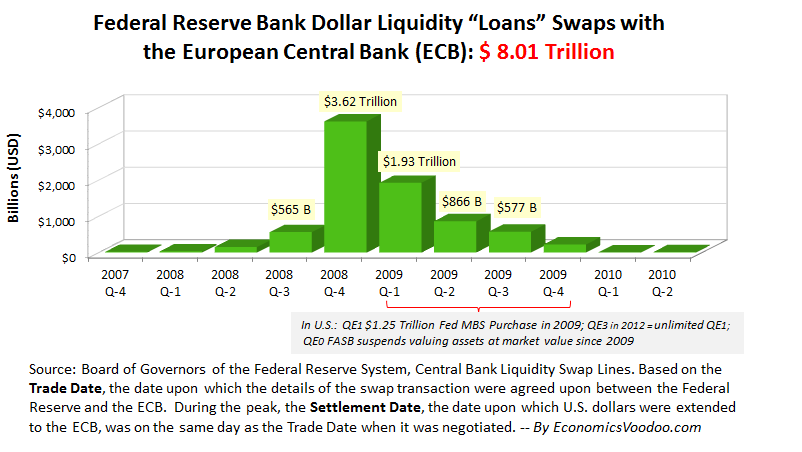
At the height of the crisis in the United States, the Federal Reserve Bank extended $8 trillion of the $10 trillion in dollar liquidity swaps to the European Central Bank through the Federal Reserve Bank’s creation of the Central Bank Liquidity Swap Lines [Data] as shown in the Voodoo Swaps Chart 1 below; swap agreements were with 14 foreign central banks. These dollar liquidity swaps in essence were loans, though not technically called loans, but merely a swap or an exchange of currencies between two central banks, neither central bank having $8.01 trillion U.S. dollars and about €6 trillion equivalent to do so.

In doing so, each central bank essentially helped the other to print dollars and euros. Another nearly $1 trillion in dollar swaps was with the Bank of England, equivalent to nearly half of the United Kingdom’s GDP.  The Federal Reserve printed dollars equivalent to 70% of U.S. GDP in 2008.

Banking & Financial Crisis 2008: Federal Reserve $8 trillion in dollar "loan" swaps with the European Central Bank

Voodoo Dollar-Euro Swaps Chart 1. Federal Reserve $8 Trillion in Dollar Liquidity “Loans” Swaps with the European Central Bank

TECHNICALLY, the Federal Reserve and the ECB did not swap $8.01 trillion dollars for euros at one time, as it would look somewhat problematic for the Federal Reserve Bank monetary system and the ECB because these trillions in dollars and euros do not exist. Continue reading

Welcome to Economics Voodoo!

It was not long ago in fall 2010 that I was a senior congressional staffer financial economist at the Congressional Budget Office (CBO) when I was fired after 2 ½ months for writing about the damage from the banking and financial system collapse since fall 2008. The writings included ‘robo-signing’ foreclosures as symptomatic of deeper problems in the securitization of $7 trillion mortgage bonds that CBO denied was a problem and the condition of the nation’s banks.

I was told that CBO should take the lead in treating foreclosure problems as “the kind of event of the moment where we should be adding skepticism, not just repeating the hype in the press”  and my writing about it showed “poor judgment about what is important and what isn’t.” This came from my direct report, then-CBO assistant director and chief economist, currently MIT Professor of Finance Deborah Lucas who was called by the U.S. President in 2009 to serve in a leadership role at CBO. CBO Director Douglas Elmendorf, a Harvard Ph.D. economist, agreed that such writings lacked knowledge of economics and poor communication skills for not understanding what it meant to remove them.

For those unfamiliar, CBO is a small federal agency that scores (produces cost estimates) Congress’s bills and can make or break them with its scoring. CBO’s panel of economic advisors includes Goldman Sachs, Morgan Stanley, former Federal Reserve economists, and distinguished economists from academia who are or were former scholars of the Federal Reserve.

Closure to the Congressional Inquiry

After over a year of congressional inquiry, my story was first made public in the Wall Street Journal, “Congress’s Number Cruncher Comes Under Fire,” (Feb. 2, 2012) what the Journal allowed the public to know. When the true nature of the issues would not come out, I was stunned that the congressional inquiry led by Senator Grassley, Ranking Member of the Senate Judiciary Committee, also declined to release my letter to the public to expose the issues. This happened during the week the New York Attorney’s General announced the lawsuit against MERS, but that too went silent a few days after the nationwide foreclosure settlement. All understood the ramifications of the NY AG lawsuit against MERS. Continue reading